I am an Associate Research Professor in the department of Communication at the University of Maryland, College Park. My research investigates a wide range of topics related to digital media, including emotion recognition, selfies, memes, influencers, terrible videogames, motion capture, virtual reality and empathy, among many other topics.
I am the author or coauthor of five books. Inhuman Networks: Social Media and the Archaeology of Connection (2016) examines the history of connectivity in Western culture as it crosses the development of technological, biological, financial, and social networks. Theorizing Digital Cultures (2018) provides a model for the study of digital media that synthesizes British and German approaches to media and culture. Materialist Media Theory: An Introduction (2019) attempts to update and revise the claims of Marshall McLuhan and Harold Innis in relation to a variety of recent theoretical innovations, especially New and Feminist Materialisms. The Affect Lab: The History and Limits of Measuring Emotion (2023) is a history of the American psychology of emotions through the lens of specific tools used to identify and produce emotion, using this history as a critique of any neurological or biological foundations of “affect theory.” The Influencer Factory: A Marxist Theory of Corporate Personhood on YouTube (2024), coauthored with Katherine Guinness, uses the backgrounds of YouTube influencer videos to examine the infrastructures of contemporary capitalism.
Among other awards, I’ve been the recipient of a grant from the National Endowment for the Humanities, a residency at the Media Archaeology Lab at the University of Colorado, Boulder, and was a contributor to an issue of the magazine esse: Arts + Opinions on “Empathy,” which received an honorable mention for “Best Editorial Package” from the Canadian National Magazine Awards/Les Prix du Magazine Canadien. Formerly, while I was employed at NC State, I was an NC State University Faculty Scholar, a recipient of the NC State CHASS Outstanding Junior Faculty Award in the Humanities, and recipient of the Robert M. Entman Award for Excellence in Communication Research.

This, however, is perhaps my proudest achievement. The above image is a meme by @cyborg.asm on Instagram, referencing the article “Do You Really Want to Live Forever,” which I coauthored with Katherine Guinness. The original meme can be found here and the article can be found here.
︎ close this panel (if on a mobile phone)
The De Gruyter Handbook of Digital Cultures
︎return home
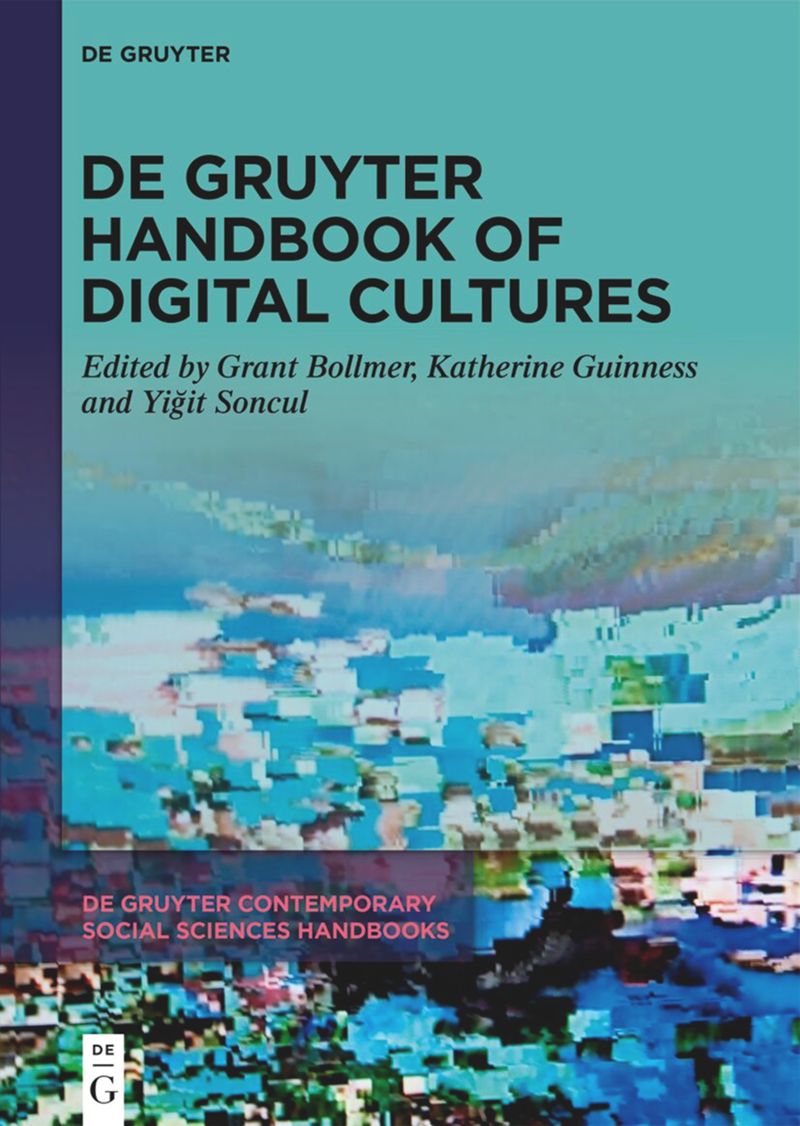
Co-edited with Katherine Guinness and Yigit Soncul
eBook published on:
September 8, 2025 eBook ISBN: 9783111316857 Hardcover published on:
September 8, 2025
Hardcover ISBN: 9783111316581
550 pages
Illustrations: 11
Coloured Illustrations: 9
Tables: 1
Buy this book from the publisher here
eBook published on:
September 8, 2025 eBook ISBN: 9783111316857 Hardcover published on:
September 8, 2025
Hardcover ISBN: 9783111316581
550 pages
Illustrations: 11
Coloured Illustrations: 9
Tables: 1
Buy this book from the publisher here
As Digital Cultures becomes the dominant term used by many across a variety of intellectual fields to describe the social, aesthetic, and political impact of digital media, it is necessary to provide a reference volume that specifies and defines the bounds of scholarly debates and curricular outlines for an otherwise amorphous interdisciplinary space.
This handbook provides a comprehensive reference for the varied methodologies, historical frames, and theoretical perspectives essential for the study of Digital Cultures today. In outlining these foundations, it serves as a practical guide for educators and students into the broad range of perspectives grouped together for the critical, historical, and social scientific study of digital media.
It also looks into the future and outlines an agenda for future research by examining not only the origins of the concept of Digital Culture, but emerging topics and themes still in development, such as the relation between digital technology and climate change, artificial intelligence and knowledge, sensation and aesthetics, and the rise of new infrastructures reinventing not only the built environment, but the boundaries of nations and sovereignty.
- The first handbook to provide the historical, theoretical, and methodological foundations for the study of Digital Culture
- Contributions by leading scholars in the field
- Discusses emerging themes and areas of research
This handbook provides a comprehensive reference for the varied methodologies, historical frames, and theoretical perspectives essential for the study of Digital Cultures today. In outlining these foundations, it serves as a practical guide for educators and students into the broad range of perspectives grouped together for the critical, historical, and social scientific study of digital media.
It also looks into the future and outlines an agenda for future research by examining not only the origins of the concept of Digital Culture, but emerging topics and themes still in development, such as the relation between digital technology and climate change, artificial intelligence and knowledge, sensation and aesthetics, and the rise of new infrastructures reinventing not only the built environment, but the boundaries of nations and sovereignty.
- The first handbook to provide the historical, theoretical, and methodological foundations for the study of Digital Culture
- Contributions by leading scholars in the field
- Discusses emerging themes and areas of research